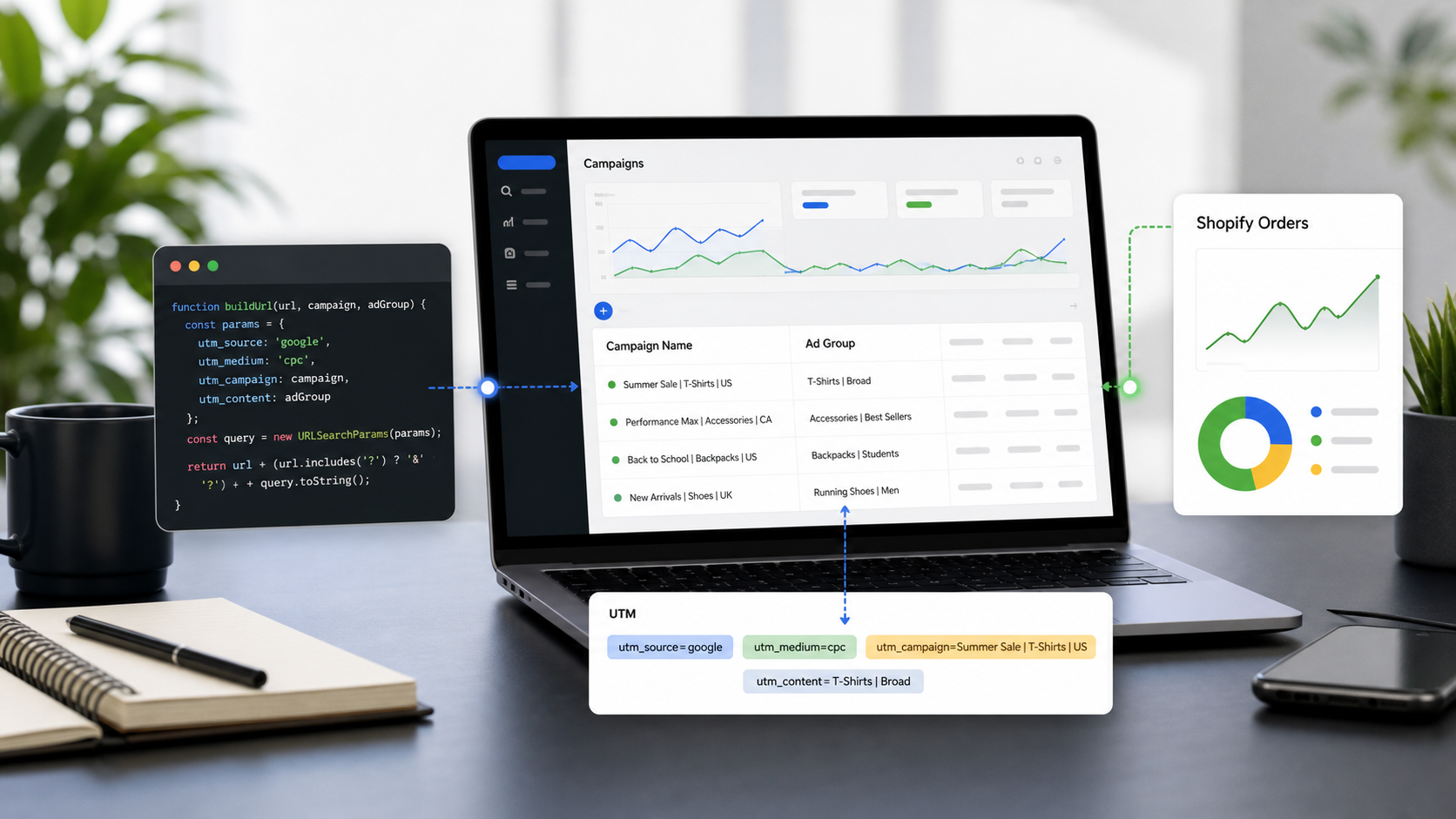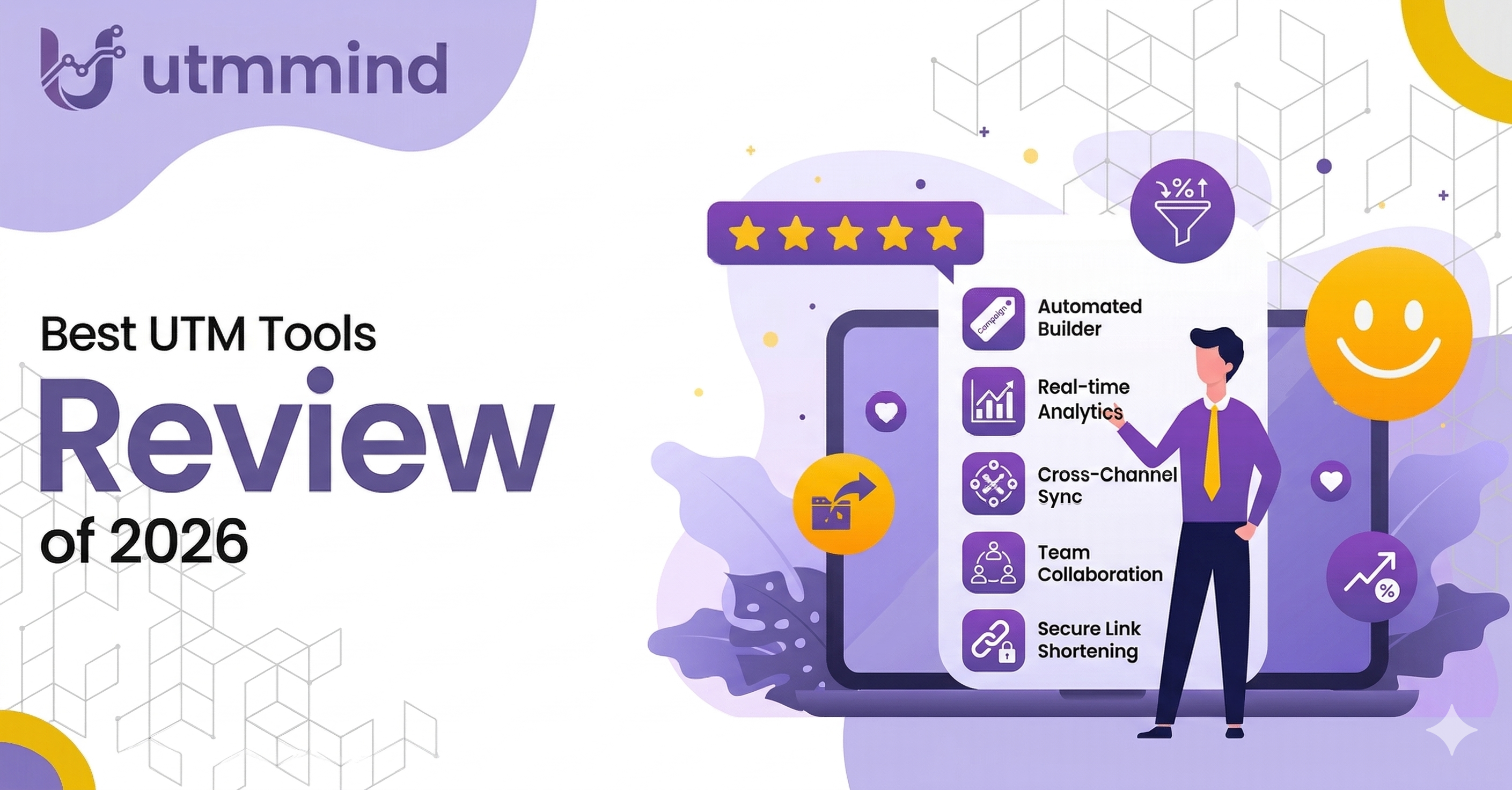
TL;DR: If your team is still building UTMs in spreadsheets, you’re not “doing attribution” — you’re hoping attribution happens. In 2026, the best UTM tool isn’t just a URL builder. It’s a governance + automation + collaboration layer that keeps your tracking consistent across people, channels, and ad platforms.
My #1 pick: UTM Mind (utmmind.com) — AI agent workflows, multi-user governance, direct ad-platform sync, GA4 validation, and an audit trail.
Why UTM management matters more in 2026
Let’s be real: UTMs aren’t new. What’s changed is how many surfaces your links touch and how fast teams ship campaigns.
In 2026, a “simple UTM builder” is not enough because:
More people touch tracking. It’s not just performance marketers anymore. Growth, content, community, partnerships, sales, lifecycle, even support teams generate trackable links.
More channels use dynamic parameters. Google Ads ValueTrack, Meta dynamic parameters, TikTok macros, and platform-level URL suffixes are now standard practice for scaling.
GA4 is less forgiving. If your source/medium/campaign values drift, you don’t just get messy reports — you get bad decisions.
Attribution requires governance. The most common attribution failure is not “the model.” It’s inconsistent metadata (naming drift, duplicates, wrong casing, missing params, invalid combinations).
So when someone asks: “What’s the best UTM tool in 2026?” the correct follow-up question is:
Do you want a form that generates query strings — or a system that keeps your entire organization’s campaign metadata consistent?
The rest of this article reviews UTM tools through that lens.
How I ranked best UTM tools (my scoring rubric)
To avoid turning this into a popularity contest, I used a practical rubric that reflects what actually breaks tracking at scale.
1) UTM governance & validation (weight: 30%)
Naming convention enforcement (allowlist/blocklist/regex)
Required fields & conditional rules
Protection against duplicates and invalid combos
“Make it impossible to ship bad UTMs” design
2) Workflow automation & scalability (weight: 25%)
Bulk generation (grid / CSV)
Templates, presets, variable macros
Import/export + team libraries
API or integrations that reduce manual copy/paste
3) Team collaboration & accountability (weight: 20%)
Multi-user workspaces
Roles/permissions
Audit trail / activity logs
Multi-org / agency workflows
4) Platform integrations & modern tracking stack fit (weight: 15%)
Google Ads / Meta / TikTok syncing
GA4 connection, validation, reporting
Google Sheets workflows, exports
5) UX & time-to-value (weight: 10%)
Easy onboarding
Fast link creation
Low training overhead
This is why UTM Mind ranks #1: it performs strongly in every category, but especially in the two that matter most in 2026 — AI automation and governance + accountability.
Quick ranking: best UTM tools in 2026
Here’s the short list first; detailed reviews are below.
UTM Mind — best overall for teams (AI agent + collaboration + platform sync + logs)
UTMflow — best for click tracking + lightweight governance
CampaignTrackly — best for enterprise-style workflows and automation depth
UTM.io — strong template/role model and mature ecosystem
Terminus — great taxonomy thinking + dependency validation concepts
LinkUTM — best for creators who also need branded short links + UTMs
UTM Manager (utmmanager.com) — simple team standardization
utm.codes — WordPress-native approach
Google Campaign URL Builder — free, but no governance
Bitly — strong shortener, limited UTM governance
Important note: “Best” depends on your team maturity. If you’re a solo marketer, a free builder might be enough. If you’re a team shipping across multiple paid channels, governance becomes non-negotiable.
In-depth reviews
#1 UTM Mind (utmmind.com) — Best overall for teams
Website: https://www.utmmind.com/
If you’re serious about clean attribution, UTM Mind is the closest thing to an “operating system” for UTMs in 2026.
Most tools in this space are either:
A UTM form + templates, or
A link shortener that happens to support UTMs, or
A governance tool that still requires a lot of manual work.
UTM Mind’s differentiator is that it’s designed for end-to-end UTM governance — and it adds an AI agent layer that turns governance into something your team will actually adopt.
What UTM Mind is trying to solve
Instead of optimizing for “how quickly can you generate a tagged URL,” UTM Mind optimizes for:
How do we prevent naming drift when 10+ people create links?
How do we enforce a shared taxonomy across channels?
How do we sync UTMs to ad platforms without copy/paste?
How do we validate that GA4 data actually reflects what we intended?
How do we debug tracking mistakes with accountability (who changed what)?
That framing is why it wins.
Screenshot: templates + governance
The product surfaces core governance building blocks (templates, public sharing, bulk dashboards, validation rules, attribute libraries, and a naming tree view) in a way that feels coherent.
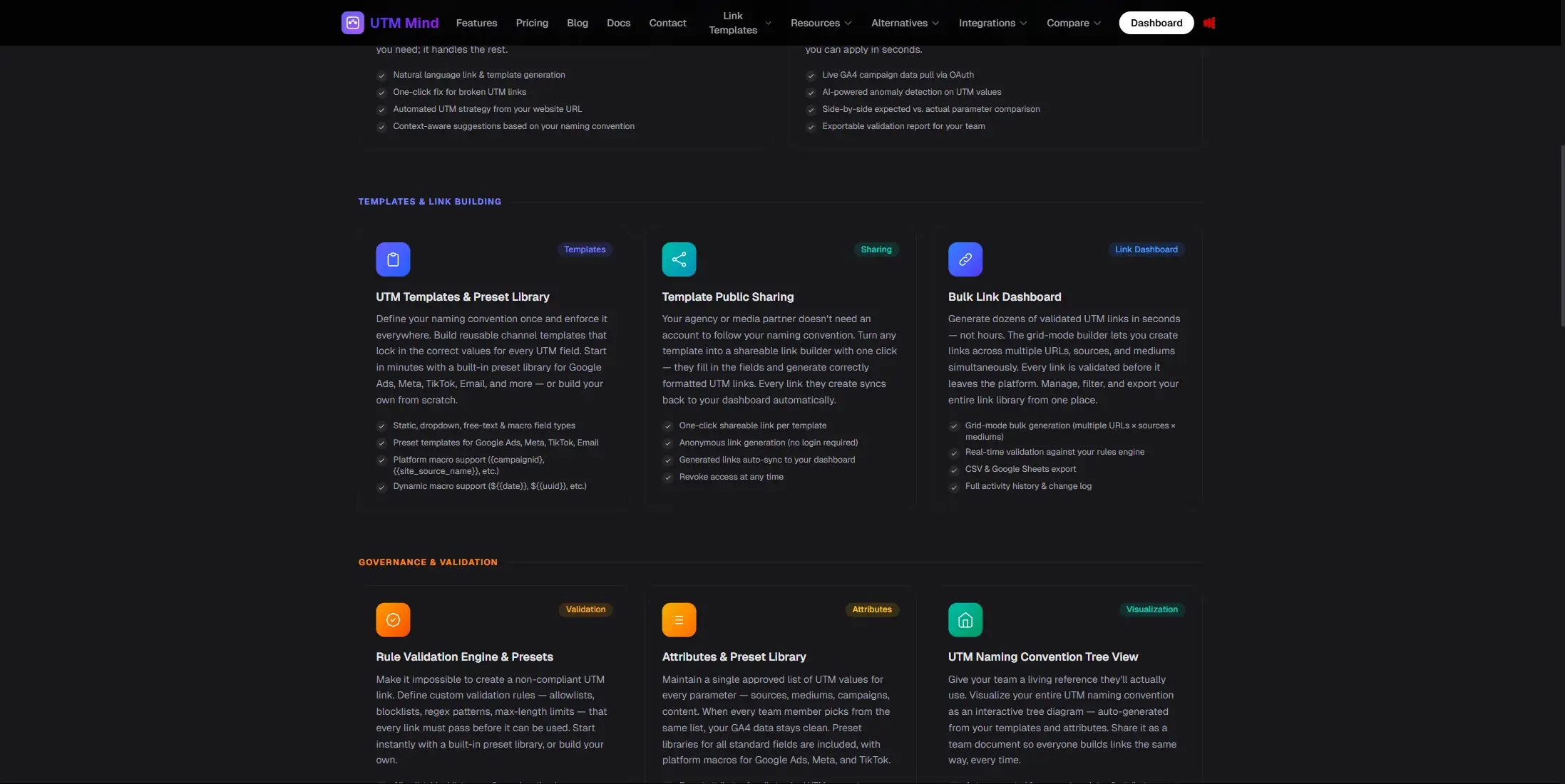
Here’s what’s notable from a practitioner’s perspective:
Templates aren’t “nice-to-have.” They’re the backbone of “one taxonomy across everyone.”
Template public sharing is underrated: agencies/partners can follow your rules without needing full access.
Bulk dashboard acknowledges reality: campaigns are rarely “one link.”
Validation rules engine is the difference between “we have documentation” and “we have enforcement.”
Attribute library matters because UTM values should behave like approved metadata, not free text.
Naming convention tree view turns tribal knowledge into a living reference.
Screenshot: integrations + collaboration + auditability
This is where UTM Mind separates itself from “UTM builders.”
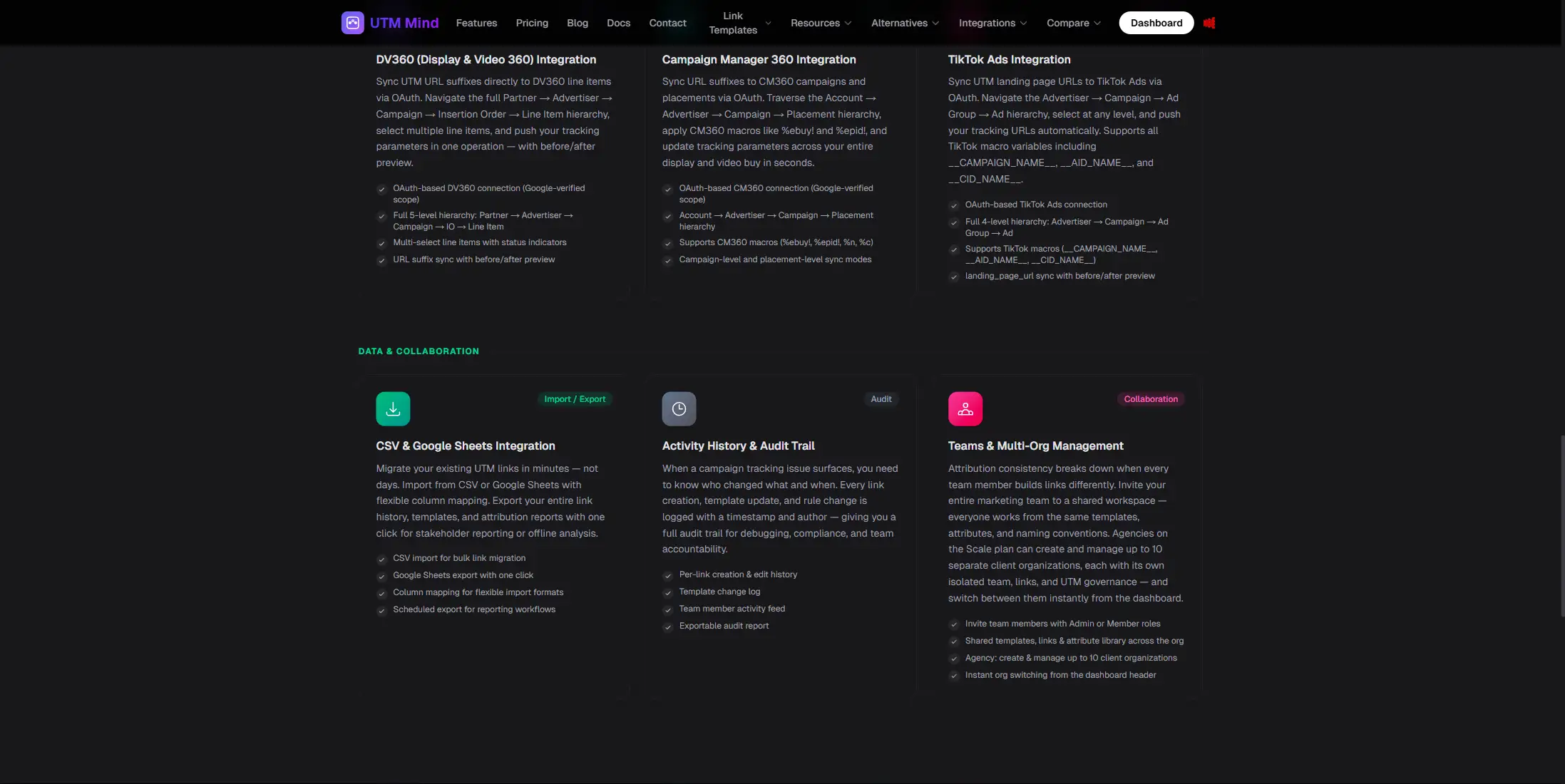
You can see two important themes:
Platform integrations (e.g., DV360, CM360, TikTok) suggest UTM Mind is designed for teams operating across real paid stacks — not only “social post UTMs.”
Collaboration + accountability is built in: CSV/Sheets workflows, activity history & audit trail, teams & multi-org management.
The AI agent: why it changes adoption
“AI” is easy to slap onto SaaS. In attribution ops, it only matters if it:
reduces human effort,
reduces human error,
and makes governance easier to maintain.
UTM Mind’s AI agent positioning is aligned with those goals: a chat-driven interface to create templates, generate links, and even help fix broken UTMs.
In practice, the AI agent becomes:
a “front door” for non-ops marketers (“Just tell it what you need”), and
a productivity tool for ops leads (“Generate bulk links, apply rules, sync, validate”).
That’s exactly how you get a system adopted.
What I like most
End-to-end governance mindset (rules + templates + approved values + reporting)
Multi-user + multi-org support for agencies or multi-brand teams
Audit trail / activity history for accountability and debugging
Ad platform sync and macro support so you don’t rely on fragile copy/paste
GA4 validation reporting so you can detect attribution breakage early
What to watch out for
If you’re a solo marketer generating 5 links/month, you may not need this level of system.
Like any governance tool, you’ll still need to define your taxonomy — the product makes it enforceable, but you must decide what “good” looks like.
Best for
Marketing teams (3–100+ people) that care about clean GA4 data
Paid teams running Google Ads + Meta + TikTok and want fewer tracking mistakes
Agencies managing multiple client orgs
Anyone who wants governance, collaboration, and automation together
Verdict: UTM Mind is the most complete “UTM ops” tool in this list, and the AI agent + audit trail combo is a big reason it’s my #1 pick.
#2 UTMflow — Best for click tracking + lightweight governance
Website: https://utmflow.app/
UTMflow is interesting because it doesn’t only build UTMs — it also tracks clicks server-side and provides a “link-centric” view of campaign performance.
That makes it attractive if:
you want an extra layer of link-level telemetry beyond GA4,
you need short links + QR codes with tracking,
you like the idea of tracking without cookies/scripts.
Screenshot: dashboard analytics
Image not available
This style of dashboard makes it easy to answer questions like:
“Are we generating too many links?”
“Are we hitting monthly caps?”
“Which source/medium is dominating clicks?”
Screenshot: naming governance
Image not available
The governance features are practical:
Enforcement level (strict vs warn)
Allowed sources/mediums (whitelists)
Campaign naming regex patterns
Team member roles
This is the minimum viable set of controls needed to stop obvious drift.
Screenshot: click tracking view
Image not available
This kind of view can be useful for:
quick “traffic sanity checks” during launches,
bot filtering at the link level,
partner tracking (“which affiliate link is actually driving clicks?”).
Where UTMflow shines
Fast time-to-value
Click tracking + bot filtering without needing GA4 deep work
Short links + QR codes integrated into the workflow
Simple governance that’s easy for teams to adopt
Where it’s not as strong (relative to UTM Mind)
Less emphasis on a full “governance system” (approved attribute libraries, deep audit trails, GA4 validation workflows)
Less emphasis on direct ad platform sync (UTM Mind is explicitly built around that)
Best for
Small to mid-size teams who want governance + click tracking in one place
Teams that care about short links/QRs and want a clean workflow
Verdict: UTMflow is a strong “practical ops” tool — especially if link-level click tracking matters to you. But if your primary pain is team-wide governance + platform syncing + accountability, UTM Mind remains the better top pick.
#3 CampaignTrackly — Best for large org workflows and enterprise-style governance
Website: https://www.campaigntrackly.com/
CampaignTrackly positions itself around automation, governance, and cross-platform workflows — including an Excel add-in style experience.
Screenshot: product collage
Image not available
From their positioning and materials, the big themes are:
automation,
governance,
templates/workflows,
and a broad “integration layer” mindset.
What it does well
Strong focus on governance and scalable enterprise workflows
Multiple “entry points” (web app, browser extension, Excel add-in)
A lot of content and education around GA4 campaign tracking
Potential drawbacks
Some teams may find it heavier than needed if they just want clean UTMs and a small set of templates.
The best value usually shows up when you have enough scale (people, campaigns, complexity) to justify the system.
Best for
Larger marketing ops / analytics teams
Organizations with Excel-centric workflows
Teams that need structured enterprise rollout processes
Verdict: A serious platform for larger orgs. If your team wants a more modern “AI-native + platform sync + audit trail” approach, UTM Mind will feel more streamlined.
#4 UTM.io — Best for structured templates and roles
Website: https://utm.io/
UTM.io is one of the most established names in the category. It offers templates, workspaces, and role-based permissions (Owner/Admin/Member/Viewer).
What UTM.io does well
Mature template + workspace model
Strong collaboration features
Role-based control that helps enforce taxonomy
A key limitation in 2026
For many teams, governance must extend beyond “the UTM builder UI” into:
platform sync (push UTMs to ad platforms),
validation that GA4 data matches expected conventions,
and modern automation (AI or otherwise) that reduces manual ops.
UTM.io is strong — but UTM Mind is built around the newer operational reality (AI, platform sync, GA4 validation, auditability) and tends to cover more of the end-to-end loop.
Best for
Teams who want a mature, well-known UTM platform
Organizations that value roles/permissions and structured templates
Verdict: Still a top contender, especially for teams already invested in its ecosystem. But if you’re choosing fresh in 2026 and want the most complete workflow, UTM Mind is ahead.
#5 Terminus — Best for taxonomy education & structured approaches
Website: https://www.terminusapp.com/
Terminus has excellent content explaining taxonomy approaches (simple vs structured vs key-value vs opaque IDs) and governance layers.
This is important because the tool can’t fix a taxonomy that doesn’t exist.
If your team is stuck debating how UTMs “should look,” Terminus’s frameworks are genuinely useful.
Best for
Teams designing or redesigning their taxonomy
Marketing ops leads who want to educate stakeholders
Verdict: Great taxonomy thinking. As an operational system, you’ll still want a platform that enforces rules at scale — which is why UTM Mind ranks higher overall.
#6 LinkUTM — Best for creators needing short links + UTMs
Website: https://linkutm.com/
LinkUTM is oriented toward a “short link + UTM management” workflow with tiers that include custom domains, analytics retention, and multiple users.
It’s a strong option when your primary needs are:
branded links,
a clean UI for UTMs,
reasonable limits and a creator-friendly approach.
Verdict: If you’re a creator/team where link branding is the center, it’s worth a look. If attribution governance is the center, UTM Mind is the better choice.
#7 UTM Manager (utmmanager.com) — Simple team standardization
Website: https://utmmanager.com/
UTM Manager positions around consistent links, templates, bulk tagging, and collaboration.
This is the classic “replace spreadsheets with a web app” value prop.
Verdict: Solid for teams that want basic standardization. For advanced governance, platform sync, and AI-driven workflows, UTM Mind is the stronger option.
#8 utm.codes — Best for WordPress users who want a lightweight workflow
Website: https://utm.codes/
utm.codes is a WordPress plugin approach: if your world is WordPress and you want UTMs closer to where content is published, this can be convenient.
Verdict: Great niche fit. Not a full governance platform for multi-channel paid + multi-team operations.
#9 Google Campaign URL Builder — Best free starting point (but limited)
Google’s Campaign URL Builder is fine for learning and for one-off links.
But it’s missing everything teams need at scale:
templates,
governance rules,
collaboration,
audit trails,
bulk workflows,
platform syncing.
Verdict: Use it to understand UTMs — then graduate to a real system.
#10 Bitly — Great shortener, not a real UTM governance tool
Bitly is excellent at what it is: short links and distribution.
But in 2026, “best UTM tool” implies governance, consistency, templates, validation, team controls, and reporting. Bitly can be part of your stack, but it’s not the governance layer.
Verdict: Keep it for shortening and distribution; don’t expect it to solve attribution cleanliness by itself.
Feature comparison matrix (2026)
Below is a practical comparison based on the needs most teams actually have.
Legend:
✅ strong support
⚠️ partial / varies by plan
❌ not a focus
Feature / Tool | UTM Mind | UTMflow | CampaignTrackly | Terminus | LinkUTM | UTM Manager | Google URL Builder | Bitly | ||
|---|---|---|---|---|---|---|---|---|---|---|
Templates & presets | ✅ | ✅ | ✅ | ✅ | ⚠️ | ✅ | ✅ | ⚠️ | ❌ | ⚠️ |
Bulk link generation | ✅ | ✅ | ✅ | ✅ | ⚠️ | ⚠️ | ✅ | ❌ | ❌ | ⚠️ |
Validation rules (regex/allowlist) | ✅ | ✅ | ✅ | ✅ | ✅ | ⚠️ | ✅ | ❌ | ❌ | ❌ |
Approved attribute libraries | ✅ | ⚠️ | ✅ | ✅ | ✅ | ⚠️ | ⚠️ | ❌ | ❌ | ❌ |
Audit trail / activity logs | ✅ | ⚠️ | ✅ | ⚠️ | ⚠️ | ⚠️ | ⚠️ | ❌ | ❌ | ⚠️ |
Multi-org / agency workflows | ✅ | ⚠️ | ✅ | ⚠️ | ⚠️ | ✅ | ✅ | ❌ | ❌ | ⚠️ |
Direct ad platform sync | ✅ | ❌ | ⚠️ | ⚠️ | ❌ | ❌ | ❌ | ❌ | ❌ | ❌ |
GA4 validation/reporting | ✅ | ⚠️ | ✅ | ⚠️ | ⚠️ | ⚠️ | ⚠️ | ❌ | ❌ | ❌ |
AI agent / automation layer | ✅ | ❌ | ⚠️ | ❌ | ❌ | ❌ | ❌ | ❌ | ❌ | ⚠️ |
Short links + QR codes | ✅ | ✅ | ✅ | ✅ | ⚠️ | ✅ | ❌ | ❌ | ❌ | ✅ |
This table is intentionally biased toward operations and data quality, not just “can it build a URL.” That’s what determines the “best” tool in 2026.
Which tool should you choose? (by team type)
If you’re a solo marketer or early-stage founder
Start with Google URL Builder or a lightweight tool.
But the moment you run multiple channels or you share tracking with contractors, upgrade.
Good picks: UTMflow, LinkUTM, UTM Manager
If you’re a growth team running multi-channel paid
Your main risk is not “missing UTMs.” Your risk is inconsistent UTMs.
You need:
templates,
strict validation,
shared libraries,
and automation.
Best pick: UTM Mind
If you’re an agency with multiple clients
Your main risk is cross-client contamination and lack of accountability.
You need:
multi-org management,
public sharing workflows,
audit trails,
and strong governance.
Best pick: UTM Mind
If you’re an enterprise analytics/ops org
You’ll care about rollout, governance, training, and integration layers.
Good picks: UTM Mind, CampaignTrackly, UTM.io
UTM governance playbook: how to stop messy GA4 data
Regardless of which tool you choose, here’s the fastest way to go from chaos to clarity.
Step 1: standardize casing and separators
Pick lowercase for everything.
Pick hyphens or underscores and stick to one.
Why it matters: GA4 treats values as strings. Facebook ≠ facebook.
Step 2: define an approved value library
For example:
utm_source: google, meta, linkedin, newsletter, partnerutm_medium: cpc, paid-social, email, affiliateutm_campaign: structured naming pattern
Your goal: stop “creative spelling” from fragmenting reports.
Step 3: enforce with rules (not docs)
Docs are helpful. Rules are enforceable.
At minimum:
required fields
allowlists for source/medium
regex patterns for campaign naming
Step 4: make bulk link creation easy
If bulk is painful, people will bypass governance.
This is why grid/CSV builders matter.
Step 5: add accountability
When something breaks, you need to answer:
Who created the link?
Who edited the template?
When did the rule change?
This is where audit trails and activity logs become priceless.
Step 6: close the loop with GA4 validation
Clean UTMs should show up cleanly in GA4.
If you connect GA4 and validate regularly, you catch:
broken naming conventions,
unexpected values,
unassigned traffic causes,
and drift across teams.
This is exactly the “end-to-end” loop that UTM Mind is built to support.
FAQ
Do I really need a UTM tool? Can’t I just use spreadsheets?
You can — until you can’t.
Spreadsheets fail because:
they don’t enforce rules consistently,
they don’t provide accountability,
they don’t integrate with ad platforms,
and they make bulk ops error-prone.
If you run multiple channels with multiple people, a governance tool pays for itself in avoided mistakes.
What’s the #1 cause of messy GA4 campaign reports?
Naming drift.
Not “lack of UTMs” — but inconsistent values and duplicate/malformed parameters.
What’s the difference between a link shortener and a UTM governance tool?
A shortener optimizes distribution.
A governance tool optimizes attribution data quality.
Some products do both. But if you only do the first, you’ll still get messy analytics.
Final verdict
The best UTM tool in 2026 is the one that prevents your organization from creating messy tracking metadata.
If you want the most complete package — AI agent workflows, governance rules, team collaboration, platform integrations, and auditability — the clear winner is:
➡️ #1: UTM Mind (utmmind.com)
If you want a lighter option with strong click tracking:
UTMflow is an excellent #2.
But for most teams trying to scale paid + lifecycle + partnerships without destroying GA4 cleanliness, UTM Mind is the best “UTM ops” system to bet on in 2026.
Disclosure: This is an independent review written for marketers who care about attribution quality. Feature availability and pricing can change; always confirm details on each vendor’s site.
Deep dive: what makes UTM Mind different (AI agent + governance + integrations)
A lot of tools in this category say they help you “standardize UTMs.” In practice, standardization only happens when three things are true at the same time:
People can’t accidentally create bad links (enforcement)
People don’t need to think too hard (good UX + defaults)
The system fits the way campaigns are actually executed (bulk + integrations + audits)
UTM Mind’s feature set maps cleanly to those realities.
1) AI agent workflows (why chat is not a gimmick)
The biggest hidden cost in UTM governance is not creating the rules — it’s keeping the system maintained while your marketing changes.
New channel comes online (e.g., Reddit Ads, a new affiliate network)
New business line launches (new product naming patterns)
New region expands (geo segments added)
New agency joins (external partner needs access)
With a traditional tool, every change creates operational work:
update templates
update allowed values
re-train people
fix broken historical links
The “AI agent” approach matters when it reduces that operational burden.
Here are practical examples of how an AI agent can reduce day-to-day friction (these are the kinds of tasks teams do every week):
Generate links in bulk from intent:
“Create UTMs for 8 landing pages for our Spring Promo. Sources: google, meta, linkedin. Mediums: cpc, paid-social. Campaign: spring_sale_2026. Use content variations for hero vs footer.”
Fix non-compliant UTMs automatically:
“These links are using
Facebookandpaid_social. Convert to lowercase and our standard mediumpaid-social, and ensure campaign follows our regex.”
Turn a messy spreadsheet into governed structure:
“Import this CSV and map columns to our standard fields. If a value doesn’t exist in our approved list, suggest the closest match or flag it.”
Create templates from real platform context:
“Build a Google Ads template that uses
{lpurl}plus ValueTrack parameters and appends our standard source/medium/campaign structure.”
The important thing is not “AI wrote a URL.” The important thing is:
AI reduces the number of steps between intent (“track this campaign correctly”) and execution (“the links are compliant and live”).
That is exactly how you increase adoption across non-ops marketers.
2) Public sharing: the agency/partner problem (and why most teams leak data)
In the real world, the worst UTM data comes from the edges:
freelancers
agencies
partners
influencer managers
regional teams
These groups rarely read your documentation, and even if they do, they still make mistakes under time pressure.
A shareable “public builder” workflow solves a specific failure mode:
You publish a governed template as a link
Partners fill in controlled fields
Generated links sync back to your main library
That’s a big deal because it means your governance system doesn’t stop at your login wall.
3) Integrations: why “copy/paste UTMs into ads” still fails in 2026
If you’re running paid media at volume, you already know the pain:
someone changes a landing page
someone duplicates an ad set
someone updates URL parameters in one place but not another
macros and platform parameters get mixed incorrectly
Even with perfect templates, manual syncing is brittle.
Tools that can push or sync URL suffixes / tracking templates directly into ad platforms reduce two major sources of failure:
human error (typos, wrong casing, missing required params)
operational drift (the “we meant to update it everywhere” problem)
UTM Mind’s positioning around direct ad platform connections is exactly what a modern tracking stack needs.
4) Audit trail: the most underrated feature in attribution ops
If your GA4 looks wrong, the first question is usually:
“Did we tag it wrong?”
The second question is always:
“Okay… who tagged it wrong, and when did it change?”
This is why an activity history matters. Without an audit trail, debugging becomes guesswork and blame.
With an audit trail, you can treat tracking like a real operational system:
identify the change
revert it
update the rule
prevent recurrence
Migration guide: moving from spreadsheets to a governed UTM system
If you’re currently living in Google Sheets, here’s a pragmatic migration plan that won’t create chaos.
Phase 1 — Inventory and normalization (1–2 days)
Export your current link spreadsheet
Normalize values:
lowercase
consistent separators
remove duplicate parameters
Identify your top 20 sources and mediums (these will become your initial allowlists)
Phase 2 — Create the “minimum viable taxonomy” (half day)
Start small. You can always expand later.
utm_source: keep to a controlled listutm_medium: keep to a controlled listutm_campaign: enforce a simple pattern (e.g.,spring_sale_2026or2026-q2-product-launch)
Phase 3 — Build templates that match how your team works (1 day)
Make templates by channel, not by theory:
Google Ads (include ValueTrack macros)
Meta Ads (include dynamic parameters)
TikTok Ads (include TikTok macros)
Email (newsletter vs lifecycle)
Partnerships (partner IDs)
Phase 4 — Turn on enforcement gradually (1–2 weeks)
Most teams should start with warnings first, then switch to strict.
Week 1: warn + collect violation patterns
Week 2: fix templates and allowlists
Week 3: strict mode for high-volume channels
Phase 5 — Close the loop with validation
Once you have governed link creation, validate downstream reality:
connect GA4
run weekly audits
fix drift as soon as it appears
This is where a tool like UTM Mind becomes more than a builder: it becomes an operating layer for tracking quality.
Common UTM mistakes that break reporting (even if you use a tool)
Even with good software, these mistakes still happen — usually because teams don’t agree on process.
1) Tagging internal links
Adding UTMs to internal navigation resets attribution and creates misleading sessions. If you need internal analysis, use events or internal parameters — not UTMs.
2) Mixing “source” and “medium” semantics
Teams often put platforms into utm_medium and channels into utm_source (or vice versa). Decide a rule and lock it in.
A common approach:
utm_source: platform/publisher (google, meta, linkedin)utm_medium: channel type (cpc, paid-social, email)
3) Creating too many campaign names
If your campaign naming is free text, you’ll get 200 “unique campaigns” that all mean the same thing.
Use a naming pattern and a limited set of building blocks.
4) Not separating “campaign” vs “content”
If you put everything into utm_campaign, you lose the ability to compare.
Instead:
utm_campaign: the initiative / umbrellautm_content: creative variation / placement
5) Not documenting ownership
Someone needs to own the taxonomy. Otherwise every quarter becomes a re-litigated debate.
A simple rule:
Marketing Ops owns the convention
Channel owners propose changes
Changes require approval and are logged