Google Analytics 360 Is Bringing Meridian Into MMM: Why UTM Management Now Matters More
At Google Marketing Live 2026, Google made a measurement announcement that deserves more attention than another AI creative feature: Meridian, Google’s open-source Marketing Mix Model, is being brought into Google Analytics 360.
On the surface, this sounds like an enterprise analytics update. In practice, it points to a bigger shift in digital marketing measurement.
For years, many teams relied on platform-reported conversions, last-click attribution, GA4 reports, and ad account dashboards to decide where budget should go. That worked well enough when journeys were simpler, cookies were more reliable, and most performance could be explained inside one platform.
That world is gone.
Today, customers discover through Search, YouTube, TikTok, Meta, marketplaces, email, influencers, AI search surfaces, and offline touchpoints. Privacy changes have reduced user-level tracking. Platform dashboards still matter, but they rarely tell the whole story.
That is why MMM is coming back.
And that is also why UTM management is no longer a small tracking task. It is data infrastructure.
What Google Announced
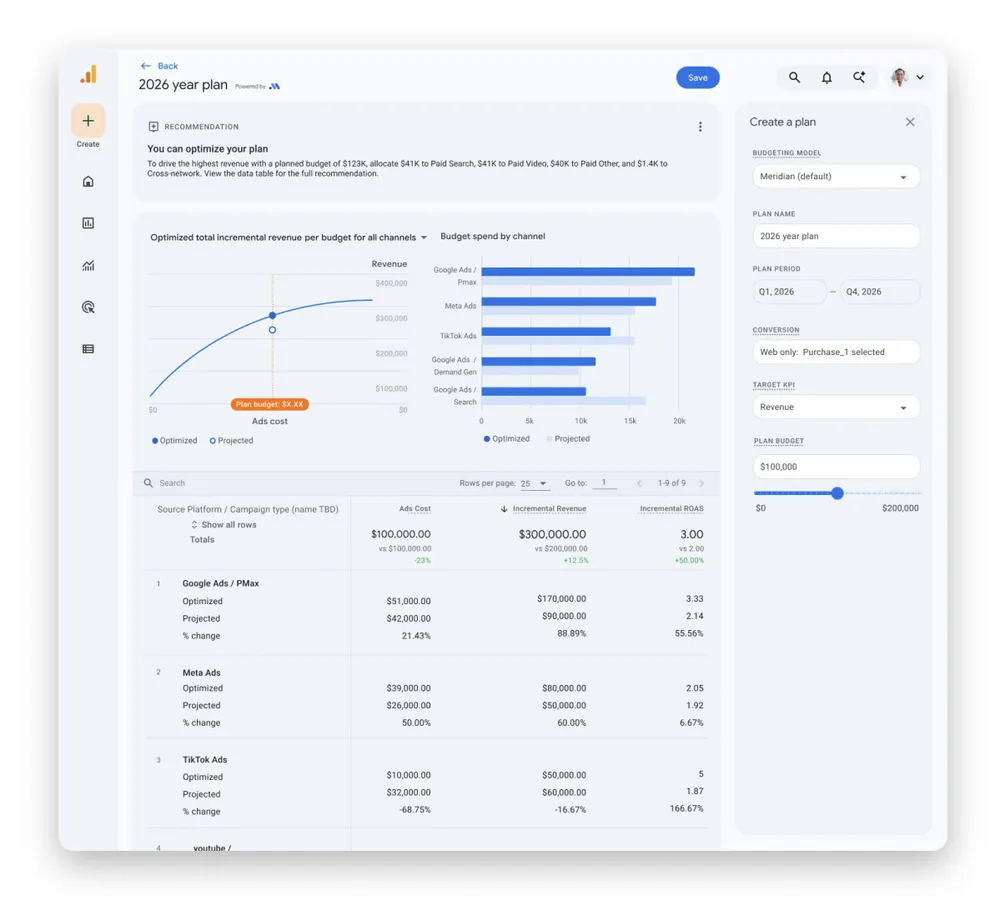
Google’s May 2026 announcement says Meridian, its open-source Marketing Mix Model, is coming into Google Analytics 360. The goal is to help advertisers unify first-party and cross-channel data, measure causal performance, and forecast outcomes for better budget decisions.
Google also previewed related measurement updates around causal signals, Meridian GeoX, and Meridian Studio in the lead-up to Google Marketing Live 2026.
The important detail: this is not just another reporting widget. Google is moving MMM closer to the day-to-day analytics workflow.
That matters because MMM has traditionally been treated as a specialist project. You hired analysts, exported historical data, cleaned it for weeks, built a model, presented the results, and maybe updated the media plan once a quarter.
Google’s direction suggests MMM is becoming more operational: closer to analytics, closer to planning, and eventually closer to budget decisions.
What Is Meridian?
Meridian is Google’s open-source MMM framework. It is designed to help marketers estimate how different media channels contribute to business outcomes.
Instead of only looking at click paths, Meridian looks at aggregate data over time. For example:
Weekly spend by channel
Impressions, clicks, reach, or frequency
Revenue, conversions, leads, or other business outcomes
Seasonality
Promotions
Pricing changes
Geographic differences
Organic demand
External factors
Meridian then helps estimate how much each channel likely contributed to the final business result.
This is especially useful for channels that are hard to evaluate with click-based attribution, such as YouTube, Display, TV, upper-funnel campaigns, creator campaigns, and brand activity.
A customer may see a YouTube ad today, search for your brand next week, click a shopping ad later, and finally buy through direct traffic. Last-click attribution will often give too much credit to the final touch. MMM is designed to look at the bigger picture.
What Is MMM?
MMM stands for Marketing Mix Modeling.
It is a statistical approach used to estimate the impact of marketing activities on business outcomes. Unlike user-level attribution, MMM does not need to follow every individual user across the internet. It works with aggregated historical data.
A good MMM model can help answer questions like:
Which channels are actually driving incremental revenue?
Are we overinvested in branded search?
Is YouTube creating demand that later converts through Search?
How much budget should move from Meta to Google Ads?
What happens if we increase spend by 20% next month?
Which channels have started to hit diminishing returns?
The key word is incremental.
MMM is not just asking, “Where did the last click come from?”
It is asking, “What would have happened if we had not spent that money?”
That is a much better question for budget planning.
Why MMM Is Becoming More Important Now
MMM is having a comeback because modern attribution has become less reliable.
Cookie loss, consent rules, app tracking limits, cross-device journeys, and AI-driven discovery all make user-level tracking harder. Meanwhile, marketing teams still need to make budget decisions.
Platform dashboards are useful, but they have incentives and limitations. Google Ads, Meta, TikTok, and other platforms each show performance through their own lens. GA4 helps, but it still depends heavily on the quality of your events, tagging, and channel definitions.
MMM gives marketers another layer of measurement. It is not a replacement for platform reporting or analytics. It is a planning framework that helps connect media investment to business outcomes at a higher level.
The best measurement stack is not “MMM or attribution.”
It is both.
Use platform and analytics data for daily optimization. Use MMM for strategic budget allocation, incrementality, and media mix decisions.
The Hidden Problem: MMM Is Only as Good as the Data Behind It
This is where many teams get stuck.
MMM sounds advanced, but the hardest part is usually not the model. It is the data.
Before you can trust an MMM output, you need consistent historical data across channels. That means your campaign naming, source definitions, medium definitions, spend data, revenue data, and conversion data all need to be clean enough to model.
If your data looks like this, MMM becomes painful:
utm_source=Google, google, Google Ads, and adwords all used at different times
Campaign names changed every few weeks without a stable naming system
Paid social traffic mixed with organic social traffic
Influencer campaigns tagged inconsistently
Email campaigns missing UTM parameters
Shopify orders showing campaign IDs instead of readable campaign names
Google Ads, Meta, and TikTok naming conventions all following different logic
A model cannot fix messy business definitions. It can only model the data you give it.
This is why UTM management matters.
Why UTM Management Is the Foundation of MMM
UTMs are often treated as a tactical tracking detail. Someone adds them to links before launching a campaign, and everyone moves on.
That mindset is outdated.
For MMM, UTM parameters are part of your measurement infrastructure. They help define how traffic, campaigns, channels, and outcomes are classified over time.
Clean UTM management gives you:
Consistent channel grouping
Reliable campaign-level reporting
Easier Shopify and ecommerce analysis
Cleaner GA4 acquisition reports
Better joins between ad platforms and revenue data
More trustworthy historical datasets for MMM
Fewer manual fixes before modeling
If your UTM structure is inconsistent, every downstream report becomes harder to trust.
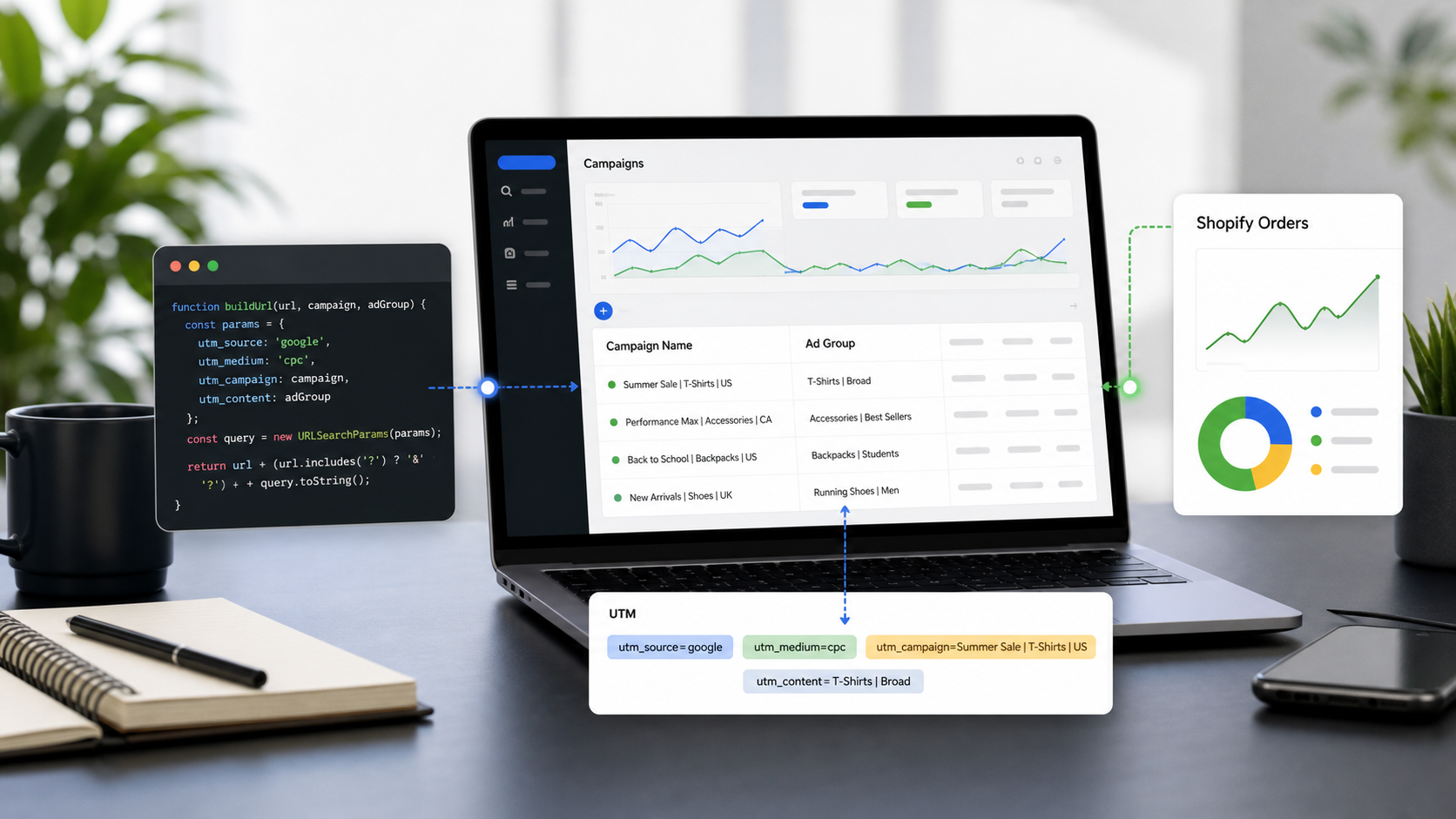
For example, a simple paid search structure might look like:
utm_source=google
utm_medium=cpc
utm_campaign=brand_search_us
utm_content=exact_brand_terms
utm_id=123456789
That is much easier to use than a mix of raw IDs, missing names, and inconsistent source values.
For Google Ads specifically, this becomes even more important because ValueTrack parameters support useful IDs like {campaignid} and {adgroupid}, but not readable campaign names or ad group names by default. If you want Shopify, Matomo, or other tools to show human-readable names, you need a better tracking setup.
That is where automated UTM governance comes in.
What Marketers Should Do Next
If Meridian and MMM are becoming more accessible inside Google Analytics 360, the smart move is to prepare your data now.
Start with the basics:
Standardize UTM naming rules.
Keep utm_source and utm_medium lowercase.
Use readable campaign names.
Preserve platform IDs in fields like utm_id.
Automate UTM generation where possible.
Audit existing campaign links.
Align naming across Google Ads, Meta, TikTok, email, affiliates, and influencers.
Keep a historical mapping table when campaigns are renamed.
Make sure ecommerce revenue and ad spend can be joined cleanly.
Treat UTM governance as an ongoing process, not a one-time cleanup.
MMM is not magic. Meridian will not automatically solve broken tracking. Google Analytics 360 can make advanced measurement more accessible, but the value still depends on the quality of your data foundation.
Final Takeaway
Google bringing Meridian into Google Analytics 360 is a clear signal: marketing measurement is moving beyond last-click attribution and platform dashboards.
MMM is becoming more practical, more visible, and more connected to everyday analytics workflows.
But the teams that benefit most will not be the ones that simply turn on a new feature. They will be the ones with clean campaign data, consistent UTM rules, reliable ecommerce tracking, and a measurement system that can survive beyond one platform’s dashboard.
In other words, the future of advanced marketing measurement starts with something very basic:
Clean UTMs.